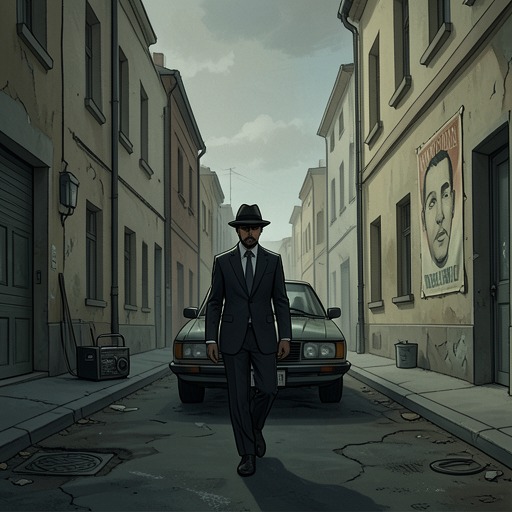
Eugène Guibaud
The Day of the JackalEugène Guibaud is the director of the French External Documentation and Counter-Espionage Service and the official who authorizes a decisive escalation in the covert struggle against the Secret Army Organisation (OAS). His importance lies less in a sustained personal presence than in the force he puts into motion: under his direction, the SDECE Action Service becomes an instrument of infiltration, intelligence gathering, abduction, and killing. Later, his reaction to the OAS leadership’s own security measures reveals a more watchful side of that authority—one alert to the possibility that apparent fear may conceal a purpose.
Office and the Action Service
The SDECE Action Service is the hard edge of Guibaud’s institution. Its headquarters occupy a complex of unremarkable buildings off Boulevard Mortier, and its roughly hundred operatives are trained at Satory Camp in small-arms fighting, unarmed combat, radio communication, demolition, sabotage, interrogation, kidnapping, arson, and assassination. Some are multilingual; all have the authority to kill in the course of their duties. The service is presented not as an ordinary administrative branch but as a body prepared to operate beyond the visible limits of conventional policing.
As OAS activity grows more violent and brutal, Guibaud removes the restraint on these operatives and sends them against the organization. Some infiltrate its upper councils, supplying information that enables the authorities to seize OAS emissaries when they enter places where police can reach them. Other wanted men, when they cannot be lured into France, are killed abroad. Relatives of men who disappear consequently suspect that the Action Service has liquidated them, although the narrative does not establish every such disappearance as its work. Guibaud’s decision thus gives the state an intelligence advantage while making the covert campaign’s human cost—and the uncertainty surrounding it—part of the conflict.
The undercover war
The OAS calls the infiltrators Barbouzes, or Bearded Ones, and hates them more than ordinary police. The name reflects their undercover role, but the violence between the organizations is not one-sided. During the final struggle for power in Algiers, the OAS captures seven Action Service operatives alive; their bodies are later found hanging from balconies and lampposts, mutilated. The full account of who tortured and killed whom in the opposing organizations’ cellars remains unknowable. Guibaud’s authorization therefore belongs to a war in which information can lead to arrest or death, and in which the opposing force answers covert violence with its own brutality.
The service’s methods also blur the distinction between official intelligence work and criminal networks. Some operatives have underworld backgrounds and retain their old contacts; on occasion they enlist former associates to carry out especially dirty work for the government. These activities feed talk of a parallel police supposedly directed by a confidant of Charles de Gaulle. The account rejects the existence of a separate parallel force: the actions attributed to it are carried out by Action Service strong-arms or temporarily recruited gang bosses. This distinction locates the controversial activity within the service Guibaud leads, even when its participants draw on connections outside government.
Watching the OAS leadership
In the last week of June, a report from the SDECE’s permanent office in Rome tells Guibaud that Marc Rodin, René Montclair, and André Casson have taken the top floor of a hotel, with the floor below reserved for their bodyguards. Eight tough former Foreign Legion members guard them around the clock, and the three leaders do not venture out. At first, the intelligence service considers whether they have gathered for a conference; as the days pass, it concludes that they are taking exceptional precautions against being kidnapped as Antoine Argoud was.
Guibaud files the report routinely and allows himself a grim smile at the spectacle of the OAS leaders sheltering behind such elaborate protection. The precautions offer a measure of satisfaction: the organization’s chiefs, who have made others vulnerable, are themselves afraid of being seized. He is pleased with the Action Service men responsible for the earlier operation against Argoud, but his response is not simple triumph. Surveying Rodin’s file, he wonders why a man of Rodin’s character should be frightened so easily. Guibaud knows that the continuing diplomatic dispute over the earlier operation makes another such abduction unlikely to receive authorization. Only later does he understand the real significance of the leaders’ precautions. The episode casts him as both the head of a covert apparatus and an intelligence reader confronted with evidence whose meaning is not yet clear.